
Building Community, One Brick at a Time by Myke Santos
With this blog we are happy to again share insight from one of our partners. We are again turning to Asia, this time Myke Santos from Brick Management Consulting
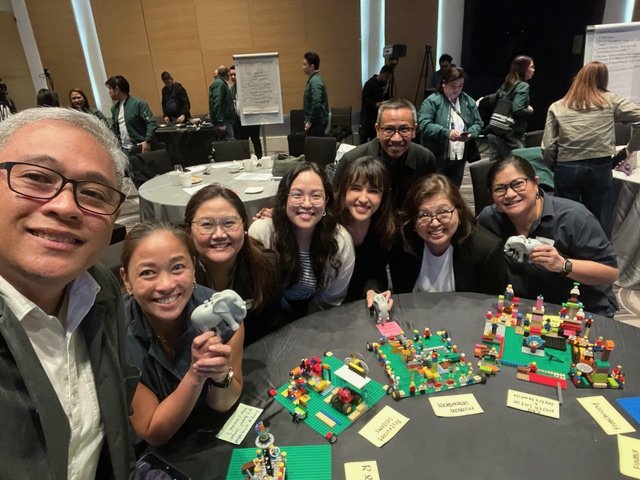
Ten years ago, I decided to leave my long-time corporate career to embark on my next adventure in entrepreneurship, and the LEGO® SERIOUS PLAY® method became not only my service offering and the latest certification on my resumé but a door to an amazing journey of self-discovery, growth, and community. A year after my certification, I stepped up to be Trivium’s partner to bring the LSP methodology into my country, the Philippines.
Having been a facilitator for change management and strategic planning in my corporate life, I was excited to share this powerful methodology that had the potential to help individuals and organizations unlock creativity, insight, and alignment in a country where the culture, like most Asian countries, tends to favor social harmony and respect for relationships and social hierarchy over courageous conversation. Together with the excitement however came a sense of responsibility and a bit of apprehension. Being one of the first facilitators in the country and bringing in the methodology meant carrying the weight of protecting the brand, nurturing the practice even if it meant building my own competitors, and well, building a community that would continue to thrive.
Over the past years and six cohorts of certification, I have had the privilege of meeting and working alongside a diverse mix of consultants, coaches, and trainers coming from different backgrounds from corporate, start-up, non-profit, to freelancing; in and outside of the Philippines. And as the community continuous to grow, a profound question begins to emerge: How might we build a genuine community of practice that safeguards the crown jewel that is the LSP method, that encourages people to build their own cathedrals, and that delivers value not only to customers but to facilitators themselves.
In my brief experience and imperfect efforts to build a thriving community, some principles or “bricks” have emerged:
1. Love of the Craft. Building an LSP community means appreciating the method as a craft – something between science and art. There are foundational skills that make one a good facilitator – active listening, crafting powerful questions, and deep presence. Meanwhile, there are also principles and practices in LSP that must be respected, observed, and guarded to preserve its authenticity and effectiveness. Since facilitators have different backgrounds, pursuits, and skill levels, it becomes important that the community becomes a safe environment where one is encouraged to:
· Practice and develop workshop design and facilitation skills
· Help others have access to bricks early as they build their own kits
· Observe one another – formally or informally – and share feedback
· Share their learnings of what worked and what didn’t
If real LSP is to be taken seriously by our clients vis-à-vis a market where there is pretend LSP, we need to take our practices and standards seriously.
2. Collaboration with Value. A mentor once told me that the difference between the corporate world and independent consulting is that in the latter, you get to learn to choose and un-choose those you work with (as opposed to having to work with your fellow employees). But that learning is a series of trial-and-error experiments that if done well, can lead to the best of professional relationships and even deep and fulfilling friendships. Collaboration cannot be built on idealism alone but must work in the real world with a level of maturity to know that:
· We can be partners in some spaces – co-designing, co-facilitating, even co-selling
· We can also be competitors in some spaces – and we share the news and congratulate whoever gets the engagement
· We can always refer one another if we see a better fit
· Large group facilitation is a great way to learn and earn together
· Be clear about commercials upfront – this is a business after all and LSP is an investment that needs a return
The key idea here is to go beyond transactional collaboration but truly investing in building long-term relationships of trust, fairness, and respect. As an LSP community we build our reputation together.
3. Helping Each Other Find their LSP Voice. I think that the true value of LSP lies in that it is difficult to commoditize when done right. Because each individual facilitator brings to the table their own unique skills, mindsets, and styles. So, it is important to encourage each other to find their authentic LSP voice. This way we can contribute to the Cathedral. A healthy community encourages the differentiation by helping each other:
· Remember that you are not selling a “LEGO” activity, you are selling solutions to client needs and problems with the distinct value that you bring to the table
· Discover your own facilitation voice – not commoditized scripts, nor imitation while maintaining the method’s integrity
· Develop Confidence in what makes you different – in terms of the problems you like solving, the markets you like serving, and the workshops that work best with those problems and markets
The goal of community-building is not to build a hierarchy of control, but an ecosystem that bring more purposeful play into the world. Because we know how much the world needs it.